Japanischer Druck "The Actor Nakamura Tomijuro I as a Shirabyoshi Dancer Performing as Ono no Komachi" von Torii Kiyohiro
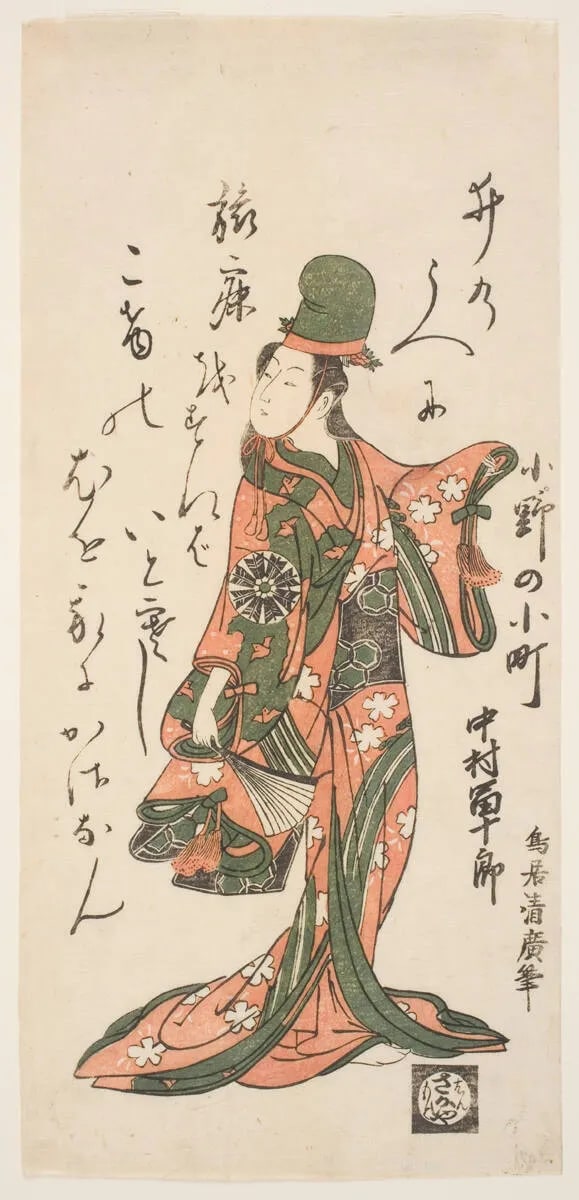
Künstler:Torii Kiyohiro
Titel:The Actor Nakamura Tomijuro I as a Shirabyoshi Dancer Performing as Ono no Komachi
Datum:1755
Details:Mehr Informationen...
Quelle:Worcester Art Museum
Durchsuchen aller 3.039 Drucke...
Beschreibung:
Benizuri-e (2-color: beni and green) Nakamura Tomijuro (1719-86) as an Osaka-born onnagata, is dressed as a female shirabyoshi dancer, with a courtier's had balanced on his head and clutching a chukei dancer's fan. Accompanying the cherry blossom motif on the robes - probably alluding to Komachi's famous poem on this theme in the "Hundred Poets" anthology - is a design of arrow fins within a roundel, which is the actor's crest.The print perhaps commemorates the performance Shida choja bashira at the Nakamura-za Theater in the 8th month of 1755 (Horeki 5), in which Tomijuroperformed the role of Ono no Otsu. The Kabuki nenpyo describes this yatsushi (tansformation of a legendary character) of Ono no Komachi (fl 833-857), a semi-legendary poet and lady-in-waiting of early Heian times [info from John Carpenter and Professor Iwata Hideyuki of Atomi College]The poem is identical, with the exception of the first word, to one included in a poetic exchange between Ono no Komachi and fellow poet Priest Henjo, recorded in Komachi shu (Komachi Anthology, nos. 34-35) as well as in the second imperial anthology, Gosen wakashu (Later Collection of Japanese Poetry, nos. 1195-96).While on a pilgrimage to the temple called Iso-nokami (Deity of the Crags), as it became dark [Komachi] decided not to return home until the next morning. Having heard that Priest Henjo was at the temple just then , she wanted to meet him and thus sent this poem:While of on a journey / I must sleep near this well / and since it is so very cold / I should like to borrow / your monastic robes of moss.(Iwa no ue ni / tabine o sureba / ito samushi / koke no koromo o / ware ni kasanan)Priest Henjo responded How can but a single layer / of these robes of moss / of one who has left the world / create a feeling of warmth / unless, that is, we sleep together?(Yo o somuku / koke no koromo wa / tada hitoe / kasaneba utoshi / iza futari nen)The suggestive repartee of this poetic exchange resonates nicely with this image of a shosagoto (kabuki dance pose), in which the turned head and gently twisted posture of the dancer may be imaginatively interpreted capturing the moment Komachi has responded to the priest's clever retort. Although the details of the plot of the Kabuki play cannot be determined , the poem cited here suggests that it was derived from the legend of Kiyomizu Komachi in which Komachi has a poetic exchange with the Pirest Henjo at Kiyomizu Temple in Kyoto. Perhaps I no ue, "above the well (or spring)," which replaces the original iwa no ue, "on a bed of rock," refers in this case to the wellspring of Otowa waterfall at Kiyomizu Temple. Or it may simply be a mistaken transcription. Koke no koromo in the poem refers to the moss-colored robes of a priest; and koke (moss) functions as an association of the word for iwa (bed of rock) in the original version of the poem. Iizuka Tomoichiro in Kabuki saiken describes many Kabuki versions of the various Komachi legends, but mentions that he had not come across records of a dramatic version based on this particular one. {Iizuka Tomoichiro, Kabuki siaken (Tokyo: Daiichi Shobo, 1926), p.30.] This print suggests that the Kiyomizu Komachi legend too, was grist for the Kabuki playwright's mitate mill.